Whitepaper
The Answerability Gap
Why the people who oversee everything struggle to answer for anything — what the research says about the problem, what psychology says about the fix, and why it cannot be solved by another dashboard.
TemporalNotes · July 2026
In brief
- A well-documented role sits above project execution — Chief of Staff, portfolio or program leader, operating executive — whose defining job is oversight without execution: answering for dozens of workstreams they do not personally run.
- The visibility pain of that role is measured, not anecdotal: roughly half of organizations lack real-time project KPIs, more than half of projects are not run by professional project managers, and the status signal arrives buried in a hundred-plus-email day.
- The industry's standard fixes — consolidated dashboards, standardized templates, reporting mandates — all require the organization to change. They routinely fail at exactly the projects that need them most.
- The failure the individual actually experiences has two modes: recall failure (“I was told, but I can't retrieve it fast enough”) and staleness failure (“nobody updated me, and I didn't notice until I was asked”).
- A fix that works for one person must respect what cognitive science says about working memory, open loops, and habit formation — which is why capture speed is not a convenience feature. It is the load-bearing design constraint.
1. The job with many names
Ask the project management profession whether this person exists and the answer is unambiguous. The industry's own hierarchy — projects deliver outputs, programs deliver outcomes, portfolios deliver strategy — creates a layer of people whose job is not to run any single piece of work, but to know the state of all of it. Depending on the organization, that person is called a Head of PMO, a Portfolio Director, a VP of Program Management, a COO — or, in founder-led and mid-size companies, a Chief of Staff: the “air traffic controller” who oversees the initiatives that don't fit neatly in the org chart, and who must obtain status from people over whom they hold no formal authority.
What unites every version of the role is a single recurring moment: someone asks where things stand, and the answer is expected immediately. The status of the vendor migration. The reason the data-center move is on hold. The realistic date for the product launch. The asker — a CEO, a board, a client — does not care that the answer lives in forty email threads, three meeting readouts, and a colleague's head.
We call the distance between what this person is accountable for and what they can answer for, right now, from memory, the answerability gap.
2. The math working against you
The gap is not a personal failing. It is arithmetic. A healthy oversight span is 20–40 concurrent priorities; cognitive psychology puts working memory at roughly four chunks of information at a time (Cowan, 2001). Everything else must live somewhere outside your head — and today, “somewhere” is a fragmented stream the research has measured in detail:
~50%
of organizations lack access to real-time project KPIs — while spending a day or more each month manually collating reports.
Wellingtone, State of Project Management
>50%
of projects are not run by professional project managers — they're run by 'accidental PMs' who don't produce disciplined status reports.
Wellingtone, State of Project Management
60%
of the knowledge-work day goes to 'work about work' — chasing status, searching for information, switching tools — rather than the job itself.
Asana, Anatomy of Work Index (13,123 workers)
117+
business emails per person per workday — with executives commonly estimated at 200+. The status signal is buried inside that stream.
Microsoft Work Trend Index; CloudHQ
Two more findings complete the picture. Project managers themselves report spending up to 30% of the workday hunting for metrics and status to deliver upward(Adobe/Workfront) — meaning even when reporting works, it is expensive. And only 36% of organizations mostly or always complete projects on time (Wellingtone), so the honest answer to “where are we?” changes constantly. Status is not a fact you can learn once. It is a stream you must continuously absorb — or continuously chase.
3. Why the standard fixes haven't fixed it
The project management industry's prescriptions converge on consolidation: a single portfolio dashboard as one source of truth, standardized red/amber/green status templates, cadenced steering reviews, mandatory reporting formats. These are good organizational medicine — and they share one structural weakness. Every one of them requires other people to change their behavior. Everyone must feed the dashboard. Every accidental PM must fill in the template, on time, honestly.
The research explains why that breaks down. The majority of projects have no professional PM feeding a standardized pipeline; the people running them are doing it alongside their real job. Reporting mandates produce the pathology practitioners call watermelon status — green on the outside until the day it flips red — because the incentive to report honestly is weakest exactly when the news is worst. And the PMO literature itself concedes the deeper point: a dashboard layered on top of fragmented, unstructured inputs doesn't create clarity — it moves confusion around faster.
For the oversight individual, there is a final, decisive constraint: you usually don't have the authority to impose any of it. A Chief of Staff cannot mandate that every workstream lead adopt a PPM suite. What remains is the only variable actually under your control: what you do with the information that reaches you.
4. The two failure modes
Watch the answerability gap up close and it always fails in one of two ways — mirror images of each other:
Recall failure. You were told. The update came — in a meeting, a hallway conversation, one of two hundred emails. But when the question arrives days later, you cannot retrieve the three things every status question is really asking: where it stands, why it is held up, and when it will land. The answer exists; the retrieval fails. So you stall, call someone back, or dig through email — the tedious ritual the role knows by heart.
Staleness failure. Nobody told you anything. The project went quiet — usually one of the majority with no real PM — and quiet feels like fine until the moment someone asks. Now the gap is worse: you don't just lack the answer, you didn't know you lacked it. The information you need exists only in someone else's head, and you needed to have asked for it last week.
Both failures produce the same visible moment — an accountable person caught without an answer — but they need different machinery. Recall failure needs a memory that structures what you're told and gives it back in seconds. Staleness failure needs a watchdog that notices silence and tells you when to go ask, and whom.
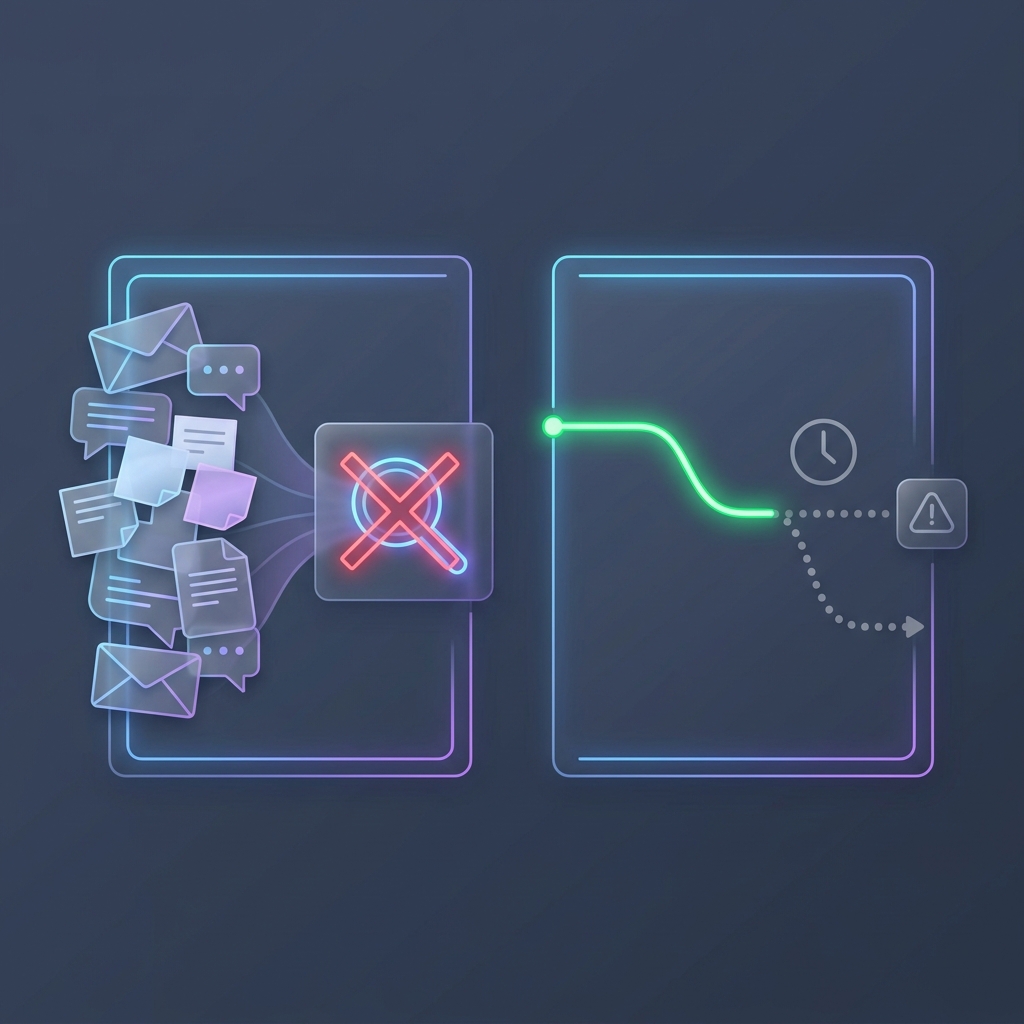
Figure 1: The two modes of tracking breakdown — retrieval failure vs. quiet drift.
5. What a real fix must respect
Any tool that closes the gap for one person — without waiting for the organization to reform — inherits four hard constraints:
It can demand nothing from anyone else. No new templates for colleagues, no adoption campaigns. One person changes: you.
It must accept information the way information actually arrives — messy, verbal, half-finished, forwarded, photographed off a whiteboard. If it demands structured data entry, it has simply relocated the reporting burden onto the one person who had the least spare time to begin with.
It must fit the moments the role actually has — the ninety seconds between meetings, the walk to the car. That is a voice-and-glance budget, not a forms-and-fields budget.
It must survive corporate reality. This person handles confidential material — deals, personnel, legal — often on a phone that corporate IT watches closely. Anything that routes company information through a third party's servers is dead on arrival, both with IT and with the user's own judgment.
6. The psychology of the seconds-long habit
The constraint that surprises people is the third one — why capture speed matters so disproportionately. The answer comes from decades of cognitive and behavioral research, and it is the reason TemporalNotes treats capture speed as an engineering requirement rather than a marketing line.
Your head is the wrong place to keep thirty open loops. Working memory holds about four chunks (Cowan, 2001). The classic Zeigarnik effect (1927) showed that unfinished business doesn't politely wait — incomplete tasks intrude on attention until they are resolved. Later work sharpened the finding in a hopeful direction: Masicampo and Baumeister (2011) found that you don't have to finish a task to quiet the intrusion — you only have to externalize a concrete plan for it. Writing the update down, with its next step, releases the mental grip. This is the scientific basis for what practitioners of Getting Things Done call a “trusted system”: the brain stops rehearsing what it believes is safely stored elsewhere — but only if the system has earned that trust by being effortless and reliably consulted.
Switching between priorities has a tax, and capture pays it down.Research on attention residue (Leroy, 2009) shows that moving from one piece of work to the next leaves part of your attention behind on the unfinished thread, degrading performance on the next thing. An oversight role is attention-residue hell: dozens of switches a day, every one leaving residue. A few-second voice capture at the moment of switching — “vendor still stuck in legal, need an answer by Thursday” — acts as a cognitive close-out. The loop is externalized; the residue has somewhere to drain; you walk into the next meeting whole.
Habits form around tiny actions attached to existing moments. Behavior design research (Fogg's behavior model; the broader habit literature) is blunt about what makes routines stick: shrink the action until it is nearly effortless, anchor it to a moment that already happens, and let a small immediate reward close the loop. The end of a meeting or call is a natural anchor that fires twenty times a week. A spoken update that takes seconds is small enough to survive a bad day — the threshold where most tracking systems die. And the reward is immediate and real: the app shows you what changed, structured, on a card — visible proof that the system heard you. Friction is the enemy of every habit; that is why there are no forms, no required fields, and no wrong way to say it.
The review ritual works because it is scheduled, bounded, and kind.Research on implementation intentions (Gollwitzer, 1999) shows that deciding when and where you will do something dramatically raises follow-through. A weekly review with a fixed slot — Sunday evening, Monday coffee — and a hard promise (“done in five minutes”) is an implementation intention with a bounded cost. Just as important is tone: guilt-driven productivity tools train their users to avoid opening them. A system that says “likely needs attention” instead of “you're behind” is not being polite — it is protecting the habit loop from the shame spiral that kills tracking apps.
Put together: the seconds-long capture is not a feature spec. It is the minimum viable transaction between a busy mind and a trusted external memory — fast enough to actually happen, structured enough to be worth retrieving, and rewarding enough to happen again tomorrow.
7. How TemporalNotes closes the gap
TemporalNotes is a private answerability layer for one person, built directly against the two failure modes and the four constraints.
Against recall failure: you speak, paste, photograph, or share the update the moment it reaches you. On-device AI structures the mess — status, deadline, owner, next step, risk — and shows you only what changed, for a one-tap confirm. Every priority then carries a current position you can retrieve in seconds: its status, the latest on why it's held up, who owns the next step, and the date. Before a status meeting, a one-screen brief assembles the position, what is fragile, and the questions worth asking. The raw input is always preserved alongside what the AI extracted — the system never rewrites your words.
Against staleness failure: every priority has an expected rhythm. When one goes quiet past it, the radar surfaces it — who owns it, how long it has been silent, what the last update said — so you check in before the surprise instead of after. The same pattern engine watches for the failure the industry knows by name: watermelon status. Statuses that regress, risks that vanish without being resolved, items that are perpetually “almost done” — flagged while there is still time to intervene.
Within the constraints: nothing about this requires anyone else to change — no colleague ever fills in a template. Capture accepts information in any form it arrives, voice first. And the architecture is the privacy stance: transcription, parsing, and pattern detection run entirely on the device. No account, no company servers, nothing collected — with optional sync through your own private iCloud. For a person carrying confidential material inside a watchful IT perimeter, that is not a compliance footnote. It is the reason this approach is deployable where every server-based alternative is not.
8. What this is not — on purpose
Candor is part of the design. TemporalNotes is not a system of record and does not replace your CRM, project tool, or spreadsheets — it is the awareness layer above them. It is single-user by design: “owner” is a label you track, not another account. It does not integrate with email or calendars; information comes in because you captured it, deliberately, in seconds. And that is the honest asterisk on everything above: the radar is only as current as what you feed it. The entire product is engineered to make feeding it nearly free — because the research, and the psychology, say that is the one behavior that has to hold.
Bottom line
The answerability gap is real, measured, and structural. It will not be closed by the next organizational dashboard, because its root causes — unstructured inputs, unmanaged projects, human reporting incentives — are precisely what organizations fail to change. It can be closed for one person at a time: a trusted external memory, fed a few seconds at a time, that remembers everything you're told and tells you when it's time to go ask.
Never be caught without an answer.
See it on your own priorities.
TemporalNotes is in private beta for people managing 20+ active priorities.
Get early accessSources
- Wellingtone, The State of Project Management (annual survey; on-time delivery, real-time KPIs, reporting burden, professional-PM coverage).
- Project Management Institute, Pulse of the Profession; PMI on the “accidental project manager.”
- Asana, Anatomy of Work Index 2021 (Sapio Research; 13,123 knowledge workers, 7 countries).
- Adobe/Workfront, State of Work (time spent locating status and metrics; managers missing information).
- Microsoft, Work Trend Index 2025; CloudHQ workplace email statistics; McKinsey Global Institute (email share of workweek).
- Cowan, N. (2001). The magical number 4 in short-term memory. Behavioral and Brain Sciences, 24(1).
- Zeigarnik, B. (1927). Das Behalten erledigter und unerledigter Handlungen. Psychologische Forschung, 9.
- Masicampo, E. J., & Baumeister, R. F. (2011). Consider it done! Plan making can eliminate the cognitive effects of unfulfilled goals. Journal of Personality and Social Psychology, 101(4).
- Leroy, S. (2009). Why is it so hard to do my work? The challenge of attention residue when switching between work tasks. Organizational Behavior and Human Decision Processes, 109(2).
- Risko, E. F., & Gilbert, S. J. (2016). Cognitive offloading. Trends in Cognitive Sciences, 20(9).
- Gollwitzer, P. M. (1999). Implementation intentions: Strong effects of simple plans. American Psychologist, 54(7).
- Fogg, B. J. (2020). Tiny Habits; Allen, D. (2001). Getting Things Done (trusted-system principle).
Figures are drawn from independent surveys and peer-reviewed research; survey figures vary somewhat across editions and are labeled by source. No vendor case-study claims are used.